Featured Post

90 Days & Beyond

To say that I have been under intense personal construction and refinement these past months is an understatement. The choice to "not ...

Friday, February 28, 2014

Free March Workout

March 2014 Workout

Tri-TriSets 2-4 times

DB Bulgarian Split Squats
Stability Ball DB Reverse Fly
Stability Ball Reverse Crunch

Push Ups
DB Suitcase Squats
Stability Ball Jacknives 


Want other Free Workouts?  

Thursday, February 27, 2014

Restaurant Survival

from 7/27/12 Post:


HELP!  Is what I hear a lot of regarding how to "eat out" and not completely screw up fat loss success.  Planning ahead is always a good idea.  There are numerous ways to find out the nutritional information for any particular restaurant....easiest way is to simply Google it.  Some restaurants offer their nutritional info and for those restaurants that do not, there are tons of free sites offering up the info.  If you have a smart phone, there are free apps you can download such as Calorie, Fast Food, etc., that provide both fast food and sit down restaurant nutritional info at a quick glance and search.  Whether you look up the info on the ride over to the restaurant, or in advance planning, knowing what you are choosing is the best way to side step the pitfalls of a restaurant experience and not falling "victim" to the head trips of what only looks like the healthier option.

Wednesday, February 26, 2014

Yoga Styles

from 3/28/13 Post:


According to Yoga Journal there are as many as 280 different styles of yoga.  Finding the right style to fit both your body and personality takes just a bit of time to examine an explanation as to each style and some experimentation with the few of your choosing.  Know too that just as anything in life, there are good teachers and bad teachers...so, if you are really interested in a style but didn't care for an experience you had, maybe try a different teacher and/or studio.  Below you will find a brief explanation from Yoga Journal as to a few of the more popular styles.  If you are interested in taking a short quiz which will help you learn what style might best fit your individual self, go to: http://www.yogajournal.com/lifestyle/quizzes_and_tools/stylequiz Namaste! 

Below is from http://www.yogajournal.com/basics/165:

To get started on your individual yoga quest, it's helpful to begin with a list that clearly prioritizes what needs you want to fulfill: Are you looking to sweat your way into a lean form, or does a gentler, more meditative approach sound more appealing?

"Not all practices fit into nice little cubby holes," warns Bender Birch. "There's a great deal of crossover among the various yoga schools, and there's even a diversity in teaching approaches within each discipline."

Try attending a few different types of classes, and you'll quickly discover the right match to suit your needs. Below you'll find brief descriptions of some of the hatha yoga disciplines that are being practiced in the United States.
Vigorous Vinyasas
Vinyasa-style yoga combines a series of flowing postures with rhythmic breathing for an intense body-mind workout. Here are a few different types:
Ashtanga
The practice of Ashtanga that's getting mainstream attention today is a fast-paced series of sequential postures practiced by yoga master K. Pattabhi Jois, who lives in Mysore, India. Today, yogis continue to spread Jois's teachings worldwide, making it one of the most popular schools of yoga around.

The system is based on six series of asanas which increase in difficulty, allowing students to work at their own pace. In class, you'll be led nonstop through one or more of the series. There's no time for adjustments—you'll be encouraged to breathe as you move from pose to pose. Be prepared to sweat. For more information, visit Ashtanga teacher Richard Freeman's website,yogaworkshop.com.
Power Yoga
In 1995, Bender Birch set out to challenge Americans' understanding of what it really means to be fit with her book Power Yoga. Bender Birch's intention was to give a Western spin to the practice of Ashtanga Yoga, a challenging and disciplined series of poses designed to create heat and energy flow.

"Most people wouldn't take a class called Ashtanga Yoga, because they had no idea what it meant. Power Yoga, on the other hand, was something Americans could relate to and know that they'd get a good workout," says Bender Birch.

Power Yoga's popularity has spread to health clubs across the country and has taken on a broad range of applications. The common thread is a rigorous workout that develops strength and flexibility while keeping students on the move. For specifics, consult individual instructors before signing up for a class. For more information visit Thom Birch and Beryl Bender Birch's website, power-yoga.com or Bryan Kest's website poweryoga.com.
Jivamukti
Looking for a highly meditative but physically challenging form of yoga? Try Jivamukti. You won't be alone.

Each week, more than 2,000 people visit the Jivamukti Yoga Center in New York City. Its popularity lies in the teaching approach of cofounders David Life and Sharon Gannon, who opened their first studio in 1986, combining an Ashtanga background with a variety of ancient and modern spiritual teachings. In addition to vinyasa-style asanas, classes include chanting, meditation, readings, music, and affirmations. This spiritual resource center also offers specialized courses in Sanskrit and the sacred yoga texts.

"Over the course of time, students will get a broad yoga education," Life promises. "One week, a class may focus on a particular asana, while the next week's theme may discuss more metaphysical issues."

Beginner classes start by emphasizing standing poses, followed by instruction on forward bends, backbends, and inversions. These classes also introduce chants. For more information on class schedules or to find a certified instructor in your area, visitjivamuktiyoga.com.
Kali Ray TriYoga
A series of flowing, dancelike movements intuitively came to Kali Ray (Kaliji) while leading a group meditation in 1980. In 1986, after developing these movements into seven distinct levels, Kaliji established the TriYoga Center in Santa Cruz, California, offering a system of yoga that is taught in a meditative environment.

The first level is a slow, relaxing, and rejuvenating practice. The class, often accompanied by music, focuses on natural alignment and breath within the flow, and ends with meditation. A union of asana (postures), pranayama (breathwork), and mudra (seals), this practice is deeply meditative, promoting relaxation and inner peace. For more information visitkaliraytriyoga.com.
White Lotus
White Lotus Yoga is the collaborative effort of Ganga White and Tracey Rich, who meld two eclectic backgrounds and years of experience into a nondogmatic teaching approach dedicated to helping students develop a well-balanced personal practice. At their 40-acre retreat in the Santa Ynez Mountains of Santa Barbara, California, this husband and wife team offers a complete yoga-immersion experience with programs ranging from weekend and weeklong getaways to 16-day teacher training programs. White Lotus Yoga is a flowing vinyasa practice which ranges from gentle to vigorous depending on your ability or comfort level. In addition, class formats incorporate alignment, breath, and the theoretical understanding of yoga. For more information, visitwhitelotus.org.

Attention to Detail

Iyengar
From his home in Pune, India, B.K.S. Iyengar reigns as one of the most influential yogis of his time. At 80 years old, he continues to teach thousands of students from all over the world, encouraging them to penetrate deeper into the experience of each pose. This is the trademark of Iyengar Yoga—an intense focus on the subtleties of each posture.

In an Iyengar class, poses (especially standing postures) are typically held much longer than in other schools of yoga, so that practitioners can pay close attention to the precise muscular and skeletal alignment this system demands. Also specific to Iyengar, which is probably the most popular type of yoga practiced in the United States, is the use of props, including belts, chairs, blocks, and blankets, to help accommodate any special needs such as injuries or structural imbalances.

"In forward bends, for example, if someone's hamstrings aren't flexible, he or she can use a prop to help extend the spine. The wall is often used for support in a variety of poses," explains Janet MacLeod, who teaches at the Iyengar Yoga Institute in San Francisco. "Using props gives the student support, allowing them more freedom to breathe deeply into the pose." For more information, visit iyisf.org.

Healing

Integrative Yoga Therapy
In 1993, Joseph Le Page, M.A., founded Integrative Yoga Therapy (IYT) in San Francisco. Le Page developed a yoga teacher-training program designed specifically for medical and mainstream wellness settings, including hospitals and rehabilitation centers.

Two-week IYT intensives are offered worldwide, training health-care professionals, yoga teachers, and bodyworkers to adapt gentle postures, guided imagery, and breathing techniques for treating specific health issues such as heart disease, psychiatric disorders, and AIDS.

"Healing happens through connection with the deepest part of who we are," says Le Page. "The program emphasizes the healing process in detail by addressing all levels of the patient—physical, emotional, and spiritual. An example of this therapeutic application is to teach patients with heart disease to become more aware of themselves and their condition at all levels, using yogic lifestyle changes, breathing techniques, asanas suitable for their condition, guided imagery for the circulatory system, and meditation with a focus on healing the heart." For more information, visit iytyogatherapy.com.
Viniyoga
As we travel through life, it's no mystery that we are constantly evolving on all levels—physically, emotionally, and intellectually. So why not tailor a yoga routine that will help address and integrate these transitions? Viniyoga, in fact, is an empowering and transformative practice designed to do just that.

In this gentle practice, created by T.K.V. Desikachar, poses are synchronized with the breath in sequences determined by the needs of the practitioner. According to Gary Kraftsow, owner and teacher at The American Viniyoga Institute on the Hawaiian island Maui, Viniyoga is a methodology for developing an integrated practice for each person's needs as they grow and change.
"As children, our practice should support balanced growth and development of the body and mind. As adults, it should protect our health and promote our ability to be productive in the world. And as seniors, it should help us maintain health and inspire a deeper quest for self-realization," says Kraftsow. For more information, visit viniyoga.com.
Svaroopa
This style of yoga teaches different ways of doing familiar poses, emphasizing the opening of the spine by beginning at the tailbone and progressing through each spinal area. Every pose integrates the foundational principles of asana, anatomy, andyoga philosophy, and emphasizes the development of transcendent inner experience, which is called svaroopa by Patanjali in the Yoga Sutra. This is a consciousness-oriented yoga that also promotes healing and transformation.
Svaroopa Yoga was developed by Rama Berch, who founded and directs the Master Yoga Academy and created the yoga program for Dr. Deepak Chopra's Center for Well Being, both located in La Jolla, California. Berch says teaching asanas became increasingly frustrating, because the students seemed to be trying to "impose the pose upon their body rather than unfolding it from within." She began looking for ways to guide her students to the deeper effects of each asana, speaking of them as "angles that provide opening, rather than poses to be learned." New students find this a very approachable style, often beginning in chair poses that are comfortable and have a deep healing effect in the spine. For more information or to find out if there is a teacher in your area, visit masteryoga.org.
Bikram
When you take a Bikram yoga class, expect to sweat. Each studio is designed to replicate yoga's birthplace climate, with temperatures pushing 100 degrees Fahrenheit.
Why the sauna-like effect? "Because sweat helps move the toxins out of your body," explains Radha Garcia, owner of Bikram's Yoga College of India in Boulder, Colorado. "Your body is like a sponge. To cleanse it, you need to wring it out to allow fresh blood and oxygen to circulate and keep your immune system running smoothly."

This method of staying healthy from the inside out was designed by Bikram Choudhury, who sequenced a series of 26 traditional hatha postures to address the proper functioning of every bodily system. 

Choudhury first visited the United States from India in 1971 on a trip sponsored by the American Medical Association to demonstrate his work using yoga to treat chronically ill patients. Today Choudhury continues teaching students of all ages and abilities from his studio in Los Angeles where he also conducts a certified teacher's training program. For more information, visitbikramyoga.com.
Phoenix Rising Yoga Therapy
Phoenix Rising Yoga Therapy is a combination of classical yoga and elements of contemporary client-centered and body-mind psychology. It can facilitate a powerful release of physical tensions and emotional blocks. Through assisted yoga postures, guided breathing, and nondirective dialogue, you can experience the connection of your physical and emotional selves, encouraging release, personal growth, and the healing of body, mind, and spirit. For more information, visit pryt.com.

Ease Into Enlightenment

Sivananda
At its core, Sivananda Yoga is geared toward helping students answer the age-old question "Who am I?" This yoga practice is based on the philosophy of Swami Sivananda of Rishikesh, India, who taught disciples to "serve, love, give, purify, meditate, realize." In order to achieve this goal, Sivananda advocated a path that would recognize and synthesize each level of the human experience including the intellect, heart, body, and mind. In 1957, his disciple Swami Vishnu-devananda introduced these teachings to an American audience. A few years later, Vishnu-devananda founded the International Sivananda Yoga Vedanta Centers, summarizing Sivananda's system into five main principles: proper exercise (asanas); proper breathing (pranayama); proper relaxation (Savasana); proper diet (vegetarian); and positive thinking (Vedanta) and meditation (dhyana).

There are more than 80 centers worldwide, as well as ashrams and teacher-training programs, all of which follow a hatha yoga practice emphasizing 12 basic postures to increase strength and flexibility of the spine. Chanting, pranayama, and meditation are also included, helping students to release stress and blocked energy. For more information, visit sivananda.org.
Integral
In 1966, the Reverend Sri Swami Satchidananda introduced an entire generation of young people to his yogic philosophy: "an easeful body, a peaceful mind, and a useful life." His goal was to help people integrate yoga's teachings into their everyday work and relationships, which he hoped would promote greater peace and tolerance worldwide.
"Integral Yoga uses classical hatha postures, which are meant to be performed as a meditation, balancing physical effort and relaxation," says Swami Ramananda, president of the New York Integral Yoga Institute in Manhattan. In addition to a gentle asana practice, classes also incorporate guided relaxation, breathing practices, sound vibration (repetition of mantra or chant), and silent meditation. For more information, visit integralyogaofnewyork.org.
Ananda
For those who aspire to loftier goals than simply building a hard body, Ananda Yoga provides a tool for spiritual growth while releasing unwanted tensions. During the 1960s, Swami Kriyananda developed Ananda as a particular style of yoga after returning to California following a period of intense yoga training under Guru Paramhansa Yogananda (author of Autobiography of a Yogi). "The most unique part of this system is the use of silent affirmations while holding a pose," says Rich McCord, director of Ananda Yoga's teacher-training program at The Expanding Light retreat center in Nevada City, California. McCord explains that the affirmations are intended to help deepen and enhance the subtle benefits of each asana, providing a technique for aligning body, energy, and mind.
In a typical class, instructors guide their students through a series of gentle hatha postures designed to move energy upward to the brain, preparing the body for meditation. Classes also focus on proper alignment, easeful posture transitions, and controlled breathing exercises (pranayama) to facilitate an exploration into the inner dimensions of yoga and self-awareness. For more information, visit expandinglight.org.
Kundalini
Kundalini Yoga, stemming from the tantra yoga path, at one time remained a closely guarded secret practiced only by a select few. In 1969, however, Yogi Bhajan decided to change this tradition by bringing Kundalini to the West. Yogi Bhajan's reasoning was based on the philosophy that it's everybody's birthright to be "healthy, happy and holy," and he believed Kundalini would help spiritual seekers from all religious paths tap into their greater potential.
The practice of Kundalini Yoga incorporates postures, dynamic breathing techniques, and chanting and meditating on mantras such as "Sat Nam" (meaning "I am truth"). Practitioners concentrate on awakening the energy at the base of the spine and drawing it upward through each of the seven chakras. For more information, visit 3HO.org.
ISHTA
ISHTA, an acronym for the Integrated Science of Hatha, Tantra, and Ayurveda, is the yoga brainchild of South African native Alan Finger, who currently runs workshops at his yoga studio in Irvington, New York. Finger blends 37 years of teaching experience with his eclectic studies under Sivananda and the tantric hermit Barati, helping students of all ages and abilities to get in touch with life's boundless energy.
"The sequence of postures is designed to help students integrate their individual sensations with a life energy force that's beyond sensing and perceiving," says Los Angeles-based ISHTA instructor Rod Stryker. "It's a tool for visualization and a way to become more fully oneself."
A typical ISHTA class mixes flowing Ashtanga-style asanas with the precise method of Iyengar, while including pranayama and meditation exercises as well. Instructors begin classes with warm-up poses, then gradually build to a more challenging practice. For more information, visit beyoga.com.
Kripalu
Located in the Berkshire region of Western Massachusetts, the Kripalu Center for Yoga and Health has helped guide thousands of people along their path of self-discovery by teaching a system of yoga developed over a 20-year period by yogi Amrit Desai and the Kripalu staff.
During the 1970s, while studying under Indian guru Kripaluvananda, Amrit felt his body begin to move in a spontaneous flow of postures without the direction of his mind. This deep release of prana (life's energy force) brought about a profound transformation in Amrit, so he developed these movements into three stages of practice which he could then teach to others.
The three stages of Kripalu yoga include: willful practice (a focus on alignment, breath, and the presence of consciousness); willful surrender (a conscious holding of the postures to the level of tolerance and beyond, deepening concentration and focus of internal thoughts and emotions); and meditation in motion (the body's complete release of internal tensions and a complete trust in the body's wisdom to perform the postures and movements needed to release physical and mental tensions and enter deep meditation). For more information, visit kripalu.org. 
Anusara
Anusara means "to step into the current of divine will." Anusara Yoga is an integrated approach to hatha yoga in which the human spirit blends with the precise science of biomechanics. It is a new system of hatha yoga that can be both spiritually inspiring and yet grounded in a deep knowledge of outer and inner body alignment. It can be therapeutically effective and physically transformative. The central philosophy of this yoga is that each person is equally divine in every part—body, mind, and spirit. Each student's various abilities and limitations are respected and honored. Anusara Yoga differentiates itself from other hatha yoga systems with three key areas of practice:

Attitude: The practitioner balances an opening to grace with an aspiration for awakening to his or her true nature.
Alignment: Each pose is performed with an integrated awareness of all the different parts of the body.
Action: Each pose is performed as an artistic expression of the heart in which muscular stability is balanced with an expansive inner freedom. For more information, visit 
anusara.com.
Tibetan
Tibetan Yoga is a term used among Buddhists to describe a range of tantric meditation and pranayama practices. Though little is known in the West about the physical practices of Tibetan Yoga, in 1939, Peter Kelder published Ancient Secret of the Fountain of Youth, describing a sequence of postures of Tibetan origin called "The Five Rites of Rejuvenation." In 1994, yoga teacher Christopher Kilham published a modern version of these exercises called The Five Tibetans: Five Dynamic Exercises for Health, Energy, and Personal Power (Inner Traditions). Composed of five flowing movements, this active workout keeps students on the move. Beginners start with 10 or 12 repetitions and progressively work their way up to the 21 repetitions of the full routine. Classes may be difficult to find.

Tibetan Buddhist monk Tarthang Tulku adapted another ancient movement practice for the modern West called Kum Nye. More contemplative in nature than the vigorous Five Tibetans, Kum Nye strives to integrate body and mind and means "interaction with the subtle body." For more information, see Tulku's Kum Nye Relaxation or visit nyingma.org.
Hatha
If you are browsing through a yoga studio's brochure of classes and the yoga offered is simply described as "hatha," chances are the teacher is offering an eclectic blend of two or more of the styles described above. It's a good idea to ask the teacher or director of the studio where he or she was trained and if the poses are held for a length of time or if you will be expected to move quickly from one pose to the next, and if meditation or chanting is included. This will give you a better idea if the class is vigorous or more meditative.

Monday, February 24, 2014

Get Spring Fit in March

The "Lose Your Pants" & "Cut" Challenges end 3/30/14 & whether you have been participating or are just now thinking getting fit before Spring would be great.....Use the month of March to spring board results!!! Focus starting this week will be on a 4 week push to get you to where you want to go! I started my "hard core" personal focus today....join me and let's get bikini ready together!!!  www.veryeffectivefitness.com/

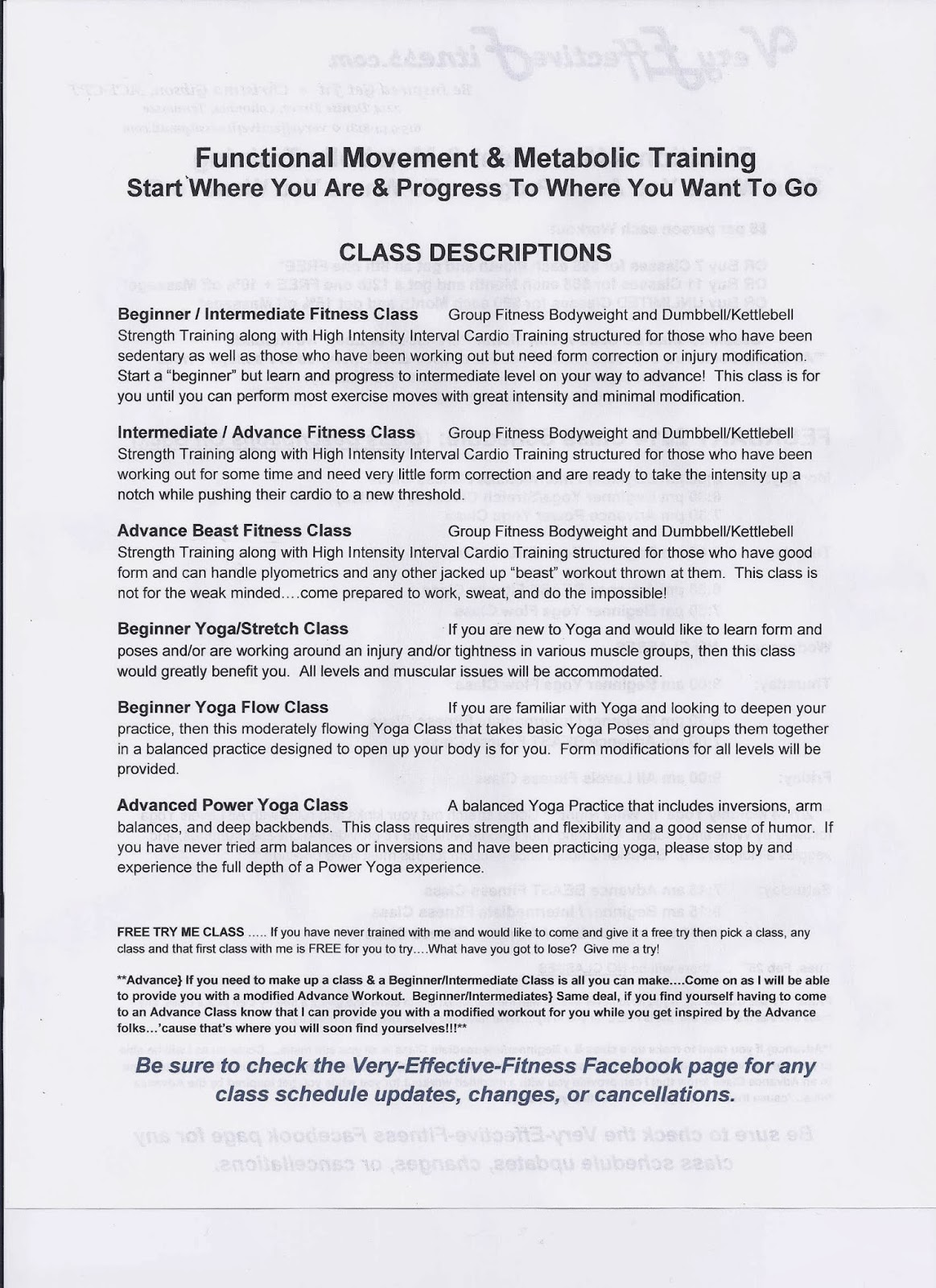
March 2014 Fitness Class Schedule.....Buy an UNLIMITED CLASSES & 15% off Massage for $90
Get Fit Before Spring!


Thursday, February 20, 2014

Only Have 10 Minutes?

from 8/9/12 Post:

This week has been insane between the many engagements with work and the kids being back in school.  So, I had to cut some corners yesterday to get in everything and one of the corners cut was my workout ;-) The usual excuse of "I didn't have time to workout" just won't cut it folks .... 'cause if you have 10 minutes, then you have time to workout and sweat!!!!  Below is the 10 minute workout I did yesterday that got my blood pumping and sweat flowing ;-)  Give it a try when you just have 10 minutes to spare!!!

10 Minute Tabata Workout

Warm Up with 10 Burpee Jacks with Push Ups, then set a timer or your Workout Muse to 20 seconds of work, 10 seconds of rest for 20 rounds.

1st Round       10-12 Push Ups
2nd Round      10-12 Y Squats
3rd Round       10-12 Push Ups
4th Round       10-12 Y Squats
5th Round       10-12 Push Ups
6th Round       10-12 Y Squats
7th Round       10-12 Reverse Lunge Kick on Right Leg
8th Round       10-12 Reverse Lunge Kick on Left Leg
9th Round       Fast Mountain Climbers
10th Round     10-12 Reverse Lunge Kick on Right Leg
11th Round     10-12 Reverse Lunge Kick on Left Leg
12th Round     Fast Mountain Climbers
13th Round     10-12 Reverse Lunge Kick on Right Leg
14th Round     10-12 Reverse Lunge Kick on Left Leg
15th Round     Fast Mountain Climbers
16th Round     Forearm Plank Hold
17th Round     Burpees
18th Round     Forearm Plank Hold
19th Round     Burpees
20th Round     Forearm Plank Hold

Wednesday, February 19, 2014

Simply Put

You cannot out workout bad eating and you cannot skimply eat and not workout and have a healthy body.  The two work together for your health and well being!  

Know that optimum fat loss and weight management is 75% what you eat.  You cannot workout and eat whatever you want and expect ideal results.  You cannot eat strictly and not workout and expect a fit body.  You need both working together to give you ideal results and a healthy, fit body.  Clean It Up x 5  &  Healthy Foods

Tuesday, February 18, 2014

Move then Move some more.....

from Jan 2012 post:


Non-Exercise Activity Thermogenesis (NEAT) is the energy expended for everything we do that is not sleeping, eating or sports-like exercise.  NEAT includes activities of daily living such as household chores and yard work, as well as, walking, playing actively with the kiddos, etc.  It has even been suggested that fidgeting, gesturing and laughing are NEAT.

It is recommended by many that you should get in 10,000 steps a day, which is roughly the equivalent of walking 5 miles.  You can buy and wear a pedometer for under $5 (or even download a tracking app to your smart phone) to get an idea of how active or sedentary you really are, which will capture all of your NEAT movement and answer the question of whether you are NEAT enough!

If the answer is that you are more sedentary than active in your daily routine, there are a lot of ways to get up and get moving throughout your day that you might not have considered such as marching in place while you are at the copier or cooking at the stove.  

From the July/August 2012 issue of Fitness magazine:

"Sitting around can make you flabby.  No surprise there, but despite what you may think, the culprit is not just a lack of exercise.  In fact, the physical act of sitting or lying down may actually speed up your body's production of fat.  When we lounge on a sofa or in a chair, we exert forces on our cells that cause them to become stretched out and to generate flab, researchers say."

CHALLENGE ALERT:  Got a good one for getting NEAT.....For Two Weeks every time you are watching TV, Reading (book or device), Playing/Looking at device or social media, or Talking on the phone....don't sit or just stand....instead, every time you are sedentarily engaged in one of these "activities" actually make it an opportunity to be active and NEAT.....March in place, jog in place, squat in place, lunge in place, ride a stationary bike, whatever it is....MOVE! 

Monday, February 17, 2014

Choose Strength Over Defeat!

from 2/27/12 post:


I saw this on a friend's Facebook page this morning:  "Rather than pray for a life that is problem-free, ask for one that is solution-full. Instead of requesting that God remove the mountain before you, seek the strength to climb it. Remember that the best students always get the toughest problems. Love the problems you have and their priceless gifts will be yours." ~Harriett M


Friday, February 14, 2014

Planting Seeds


from You Can Heal Your Life by Louise L. Hay:

"Think for a moment of a tomato plant. A healthy plant can have over a hundred tomatoes on it.  In order to get this tomato plant with all these tomatoes on it, we need to start with a small dried seed.  That seed doesn't look like a tomato plant.  It sure doesn't taste like a tomato plant.  If you didn't know for sure, you would not even believe it could be a tomato plant.  However, let's say you plant this seed in fertile soil, and you water it and let the sun shine on it.

When the first little tiny shoot comes up, you don't stomp on it and say, "That's not a tomato plant."  Rather, you look at it and say, "Oh boy!  Here it comes," and you watch it grow with delight.  In time, if you continue to water it and give it lots of sunshine and pull away any weeds, you might have a tomato plant with more than a hundred luscious tomatoes.  It all began with that one tiny seed.

It is the same with creating a new experience for yourself.  The soil you plant in is your subconscious mind.  The seed is the new affirmation.  The whole new experience is in this tiny seed.  You water it with affirmations.  You let the sunshine of positive thoughts beam on it.  You weed the garden by pulling out the negative thoughts that come up.  And when you first see the tiniest little evidence, you don't stomp on it and say, "That's not enough!"  Instead, you look at this first breakthrough and exclaim with glee, "Oh boy!  Here it comes!  It's working!"

Then you watch it grow and become your desire in manifestation."

Thursday, February 13, 2014

Tricks & Tips

from 2/13/12 post:


Everyone always wants to know what's the trick to weight loss...What's the short cut?  There isn't one is the correct answer.  But, if you are consistent with your nutrition (Eating Supportively) and with your workouts, there are some helpful tips you can try.    First know that the information contained on this blog is not medical advice and is not intended to replace the advice or attention of health-care professionals. I am not a registered dietician. Consult your physician before beginning or making changes in your diet or exercise program, for diagnosis and treatment of illness and injuries, and for advice regarding medications. That said....

*Cayenne pepper, ginger, jalapenos, any capsaicin filled spice/pepper is an excellent way to season with full body flavor and remain low sodium while increasing your metabolic rate.

*1/2 to 1 TBL pure, raw Honey with 2 TBL of raw, unfiltered Apple Cider Vinegar (mixed with 4-8 oz of warm water) before breakfast and again after dinner is a great way to stay healthy (helps fight allergies, boosts your immune system, and increases your metabolism).

*Eating cinnamon when you indulge on high-glycemic carbohydrates is a great way to minimize the insulin spike that occurs when eating such carbs.

Remember:  "In this age, which believes that there is a short cut to everything, the greatest lesson to be learned is that the most difficult way is, in the long run, the easiest."  ~Henry Miller

Slow and steady (and consistent) really does win the race!!!